TL;DR
Seated in its slot, a 10x30x2 offers only about 1.95 square feet for air to pass through, enough for a system around two tons and not much more. That matters in pollen season because the particles worth filtering are the fragments grains shed in humid air, and those fall in a range MERV 8 makes no claim about. MERV 11 is the step up most homes this size absorb without trouble. MERV 13 filters better and the EPA recommends it, though only a return with airflow to spare can feed one.
The Short Answer
MERV 11 is the practical pollen season choice for a 10x30x2 in most single-return homes, since the narrow face leaves little headroom and over-restricting slows the blower and can ice the coil. Step up in early spring, shorten the change interval while pollen is active, and measure static pressure before going higher.
Top Takeaways
• A 10x30x2 measures 9.5 by 29.5 inches seated, giving about 1.95 square feet of face area.
• Residential filters are designed for 200 to 400 feet per minute of face velocity, 500 FPM at the ceiling.
• That caps this slot near 584 CFM at 300 FPM and 778 CFM at 400 FPM, roughly two tons of cooling.
• MERV 8 carries no published rating below one micrometer. MERV 11 is rated above 20% there, MERV 13 above 50%.
• Pollen grains rupture in humidity, releasing fragments of 0.5 to 4.5 micrometers that reach the lower airways.
Does a Higher MERV Rating Actually Help with Pollen?
It does, though not for the reason most guides give, since they treat pollen as one thing when it behaves like two.
Whole grains are large. Ryegrass runs near 25 micrometers, ragweed near 17, live oak near 28, and MERV 8 is rated above 70% in the 3 to 10 micrometer band, so it catches them on the first pass.
What MERV 8 misses is what happens after a grain meets water. Rain, dew, or humid air makes it swell and rupture, and research in Environmental Health Perspectives measured the resulting particles at 0.5 to 4.5 micrometers, still carrying allergenic proteins and small enough to reach the lower airways.
Set that against DOE’s published efficiency table and the gap shows up clearly:
• Fragments span all three rated bands, from 0.5 up past 4.5 micrometers.
• MERV 8 is rated above 20% in the 1 to 3 micrometer band and carries no published rating below 1 micrometer.
• MERV 11 is rated above 65% in the 1 to 3 band and above 20% below 1.
• MERV 13 is rated above 85% and above 50% in those same bands.
A missing rating below one micrometer does not mean MERV 8 captures nothing there, only that the manufacturer makes no claim. When the particles you care about sit where your filter makes no promises, you have your reason to step up.
The same mechanism explains what allergy sufferers describe every spring: symptoms spike the day after a storm even as the count falls, because the count measures grains while the air carries fragments.
Why the Face of a 10x30x2 Filter Limits Your Options
The EPA’s guidance is to select a filter rated at least MERV 13, or as high as your system will accommodate. That second clause is generous on most systems, but on a 10x30x2 it is the whole question.
The nominal size reads as 300 square inches, though the filter that seats measures 9.5 by 29.5, leaving about 1.95 square feet of working face.
DOE guidance caps residential face velocity at 500 feet per minute and prefers 200 to 400. Against 1.95 square feet that gives roughly 584 CFM at 300 FPM, 778 at 400, and 973 at the ceiling. Since a system moves about 400 CFM per ton, this slot suits two tons and runs out near 2.4.
Put one in as the only return on a three-ton system and it passes that ceiling before anyone touches a rating. Sitting behind a grille costs more, since its free area narrows the opening further, which is why the field rule allows only about 2 CFM per square inch, closer to 560 CFM here.
What Over-Restricting a Narrow Return Actually Does
Which failure you get depends on the blower motor. A permanent split capacitor motor cannot adjust its speed, and DOE guidance describes it working to roughly 0.5 inches water column before falling off, at which point it stops pushing while the fan keeps turning. An electronically commutated motor does the opposite, chasing its airflow target until it works itself to burnout.
Most systems stay under 0.4 to 0.5 inches water column across filters, coils, and ducts, so a filter dropping 0.25 inches takes half the budget by itself. In humid climates that restriction cools supply air past design, letting attic ducts sweat below dew point and icing the coil.
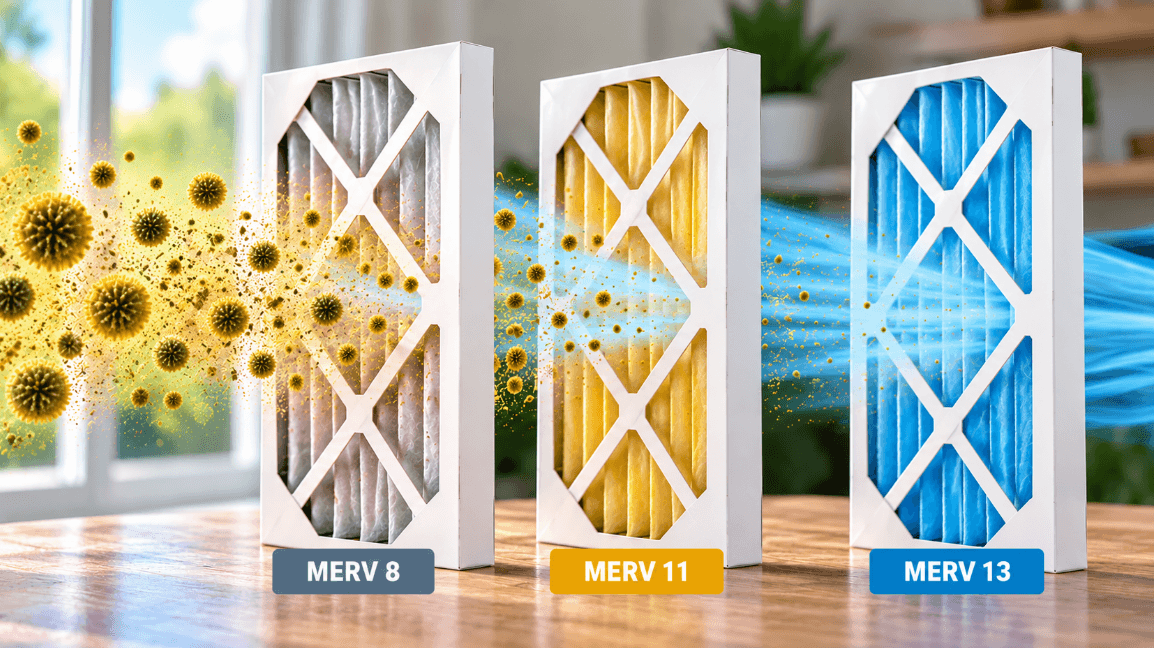
MERV 8, MERV 11, and MERV 13 in a Two-Inch Slot
Thickness earns as much as rating here. DOE figures for one manufacturer’s MERV 7 line show 0.20 inches water column for the one-inch at 300 FPM against 0.13 for the two-inch and 0.12 for the four-inch, putting a two-inch slot most of the way to four.
MERV 8
Handles dust, lint, and whole grains, with no rated capture in the finest band. Right when nobody has seasonal symptoms, or when your 10x30x2 is the sole return above two tons.
MERV 11
Rated above 65% in the 1 to 3 micrometer band, where most fragments, mold spores, and dander end up. On a single-return 10x30x2 this is the balanced seasonal choice.
MERV 13
Rated above 50% in the finest band and the level the EPA points toward, so there is no arguing it filters better. Use it with a second return, a variable speed blower, or a static pressure reading confirming the headroom. To check specifications against your slot, you can see all three ratings stocked in this size.
How to Get the Two Numbers This Decision Needs
Everything above rests on two facts about your house, neither printed on the filter box, both findable in ten minutes.
Find your tonnage. Read the outdoor condenser nameplate, where a three-digit group in the model number gives cooling capacity in thousands of BTU per hour. Divide by 12: 018 is 1.5 tons, 024 is 2, 036 is 3, 048 is 4, 060 is 5. Multiply by 400 for the CFM your filter has to pass.
Count your returns. Look for grilles that pull air in rather than push it out, holding a tissue to each while the system runs. If it sticks, that is a return. One return sends full CFM through your 10x30x2, two halve each filter share, and three or more usually leaves room for MERV 13.
Run the free airflow test. With the system running, check the register farthest from the air handler, then pull the filter, wait two minutes, and check again. Noticeable improvement tells you the filter is already restricting airflow and a higher rating will worsen it. Put it back right away, since running without one lets dust reach the coil and blower.
What to Do if You Want MERV 13 and Your Return Cannot Take It
The EPA recommends MERV 13, and your 10x30x2 on a three-ton single return cannot feed it. Both stay true, which leaves four ways forward.
1. Add a second return. Most effective and most expensive, since two filters roughly halve face velocity.
2. Convert to a deeper cabinet. Four or five inches of media buys more pleat surface at lower resistance.
3. Run MERV 11 in the ducts and put a portable HEPA unit in the bedroom. Cheapest and often most practical.
4. Run MERV 13 on a short interval. Worth doing only with a measured static pressure reading.
That third option deserves more credit. Filtration only works while the system runs, and a central system runs a fraction of the day, whereas a portable unit works through the hours your airway is most exposed.
How Often to Change During Pollen Season
The EPA notes manufacturers typically recommend replacement every 60 to 90 days, and on a narrow filter in pollen season you want the short end. Less media means faster loading, and DOE guidance is blunt that accumulated dirt greatly increases pressure drop, with clogging and collapse more likely at higher MERV. A clean MERV 11 behaves well in April and has you calling about a warm bedroom by May. Hold it to a light monthly, replacing it once light stops passing through.
Four Sources that Settle a Filter Decision
Get the federal recommendation before you shop. The EPA’s consumer guide gives the baseline: MERV 13, or the highest rating your system accommodates. EPA Guide to Air Cleaners in the Home
Check whether your return can feed a higher rating. DOE publishes efficiency by particle size, pressure drop by thickness, and design face velocity ranges, all needed to weigh a rating change. DOE Building America Solution Center
Understand why symptoms spike when counts drop. Environmental Health Perspectives covers how ragweed grains release respirable fragments, the answer when symptoms refuse to track the forecast. Environmental Health Perspectives
Build a pollen plan beyond the filter. The Asthma and Allergy Foundation of America covers pollen seasons by plant type alongside controls that work with filtration. Asthma and Allergy Foundation of America
3 Supporting Statistics
One in four adults has a seasonal allergy.
• 25.2% of U.S. adults carry a diagnosed seasonal allergy
• 20.6% of children do
• Women are affected more than men, 29.5% against 20.7%
Source: CDC National Center for Health Statistics, NHIS 2024
Two-thirds of homes cool through ducts.
• 88% of U.S. households use air conditioning
• Two-thirds use central AC or a heat pump
• All of them pull air through a filter
Source: U.S. Energy Information Administration, RECS
Pollen season starts about 20 days earlier than in 1990.
• Start date moved roughly 20 days earlier between 1990 and 2018
• Season length grew by about 8 days
• Concentrations rose about 21%
• Based on 60 monitoring stations and 821 site-years
Source: Proceedings of the National Academy of Sciences
An earlier start puts a habitual spring change behind the season.
Final Thoughts
Working through this one changed how I would answer the question, because I started out treating it as a filtration problem and finished treating it as an airflow problem.
The EPA is right that MERV 13 is the target and most systems handle it, but that guidance assumes a return sized for the equipment behind it, and on a 10x30x2 the assumption is worth checking rather than inheriting. Two square feet is not much face area, and whether MERV 13 runs quietly or ices a coil in August comes down to your return count and your static pressure.
So my position on this size is MERV 11 through spring, held year round, changed more often while pollen is active. If you want MERV 13, and the EPA would rather you did, measure first.
Next Steps
Count your returns and check your filter against 9.5 by 29.5 inches seated. A single return above two tons means booking a static pressure reading before changing ratings, while two returns make MERV 11 a safe upgrade this week.
Frequently Asked Questions
Is MERV 13 too restrictive for a 10x30x2 filter?
Not inherently, and the EPA notes most systems accommodate it. The concern here is face area, since 1.95 square feet supports roughly 584 to 778 CFM within the preferred range. On a single return above two tons, measure first.
Will MERV 11 help with pet dander as well as pollen?
Yes. Dander overlaps the same fine particle range as pollen fragments, and MERV 11 is rated above 65% in the 1 to 3 micrometer band where much of it sits.
Should I run the higher rating year round?
For most households yes, provided the system tolerated it, since dander, mold spores, and cooking aerosols never take a season off. Step back only after long run times, weak airflow at distant registers, or coil icing.
How do I know if my filter is restricting airflow?
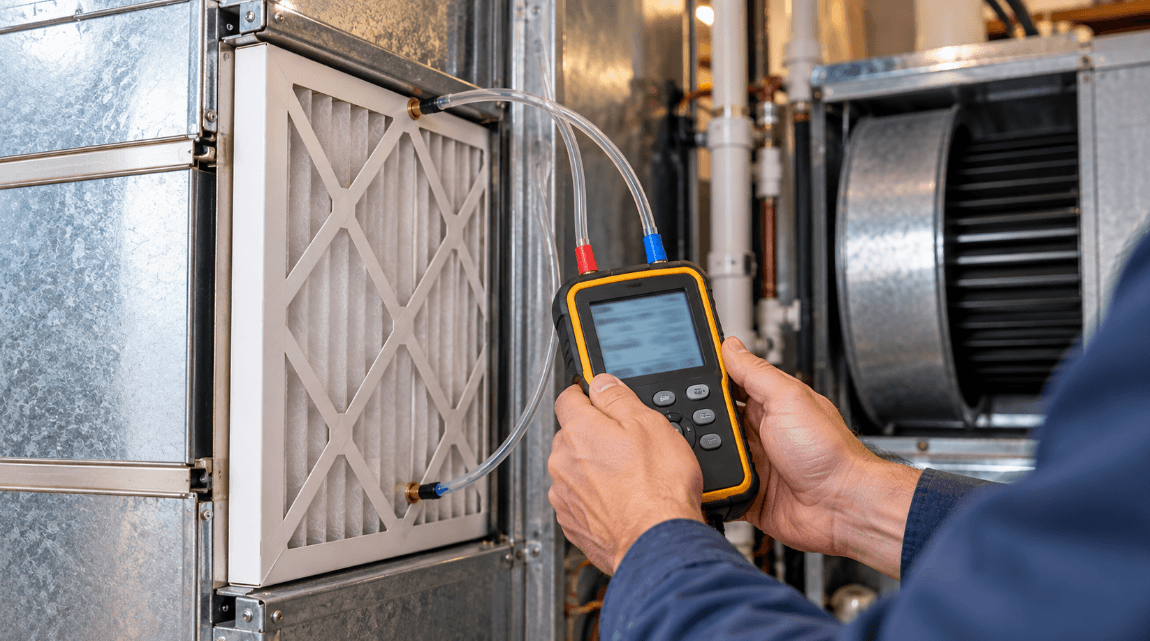
Watch for long run times, weak airflow at far rooms, a whistle at the return grille, or ice on the coil. A technician measures total static pressure with a manometer, adding supply and return readings, and the result should land at or below 0.4 to 0.5 inches water column.
Glossary
MERV. Minimum Efficiency Reporting Value, the scale for how much of a particle size range a filter removes, reported across three bands: 0.3 to 1.0, 1.0 to 3.0, and 3.0 to 10.0 micrometers.
Face velocity. The speed of air through the filter face in feet per minute, designed at 200 to 400 FPM residentially with 500 the practical maximum.
Static pressure. The resistance the blower works against, held in most homes to 0.4 or 0.5 inches water column total.
PSC and ECM motors. A PSC blower loses airflow as static pressure climbs, while an ECM chases its airflow target and can burn out instead.
Subpollen particle. A fragment released when a pollen grain absorbs moisture and ruptures, carrying the same allergenic proteins at a fraction of the size.
Filterbuy. Filterbuy is a United States air filter manufacturer that produces pleated HVAC filters in more than 600 sizes, including two-inch filters in MERV 8, MERV 11, and MERV 13.
Learn more about HVAC Care from one of our HVAC solutions branches…
Filterbuy HVAC Solutions - Miami FL - Air Conditioning Service
1300 S Miami Ave Apt 4806 Miami FL 33130
(305) 306-5027
https://maps.app.goo.gl/Ci1vrL596LhvXKU79