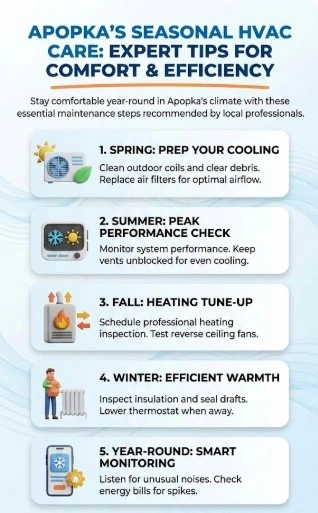
Apopka's climate puts HVAC systems through a stress test most equipment wasn't designed for. Our technicians respond to the same preventable emergencies every year—flooded drain pans in July, heat pumps that quit during January cold fronts, and compressors that fail right when afternoon thunderstorms push humidity past 80%.
After thousands of service calls across Orange County, we've identified the seasonal maintenance steps that actually prevent these breakdowns versus the generic checklists you'll find elsewhere. This guide shares what we've learned works specifically for Apopka homes—from the older systems in Lake Ola Estates to the newer builds near Wekiwa Springs.
You'll get our season-by-season maintenance priorities based on when we see the most emergency calls and what causes them.
Quick Answers
HVAC Repair in Apopka
Apopka homeowners need HVAC repair contractors who understand Central Florida's unique climate demands. After thousands of service calls across Orange County, here's what we recommend:
Before hiring any contractor:
Verify state license at MyFloridaLicense.com
Confirm they pull Orange County permits
Check BBB ratings and complaint history
Typical repair costs: $150–$500 for standard repairs. Compressor and blower motor work runs higher.
Most common repairs we see locally:
Clogged condensate drain lines (summer)
Failed capacitors (year-round)
Refrigerant leaks (often from aging coils)
Heat pump issues (winter)
When to repair vs. replace: If your system is 12+ years old and repair costs exceed 50% of replacement price, new equipment usually makes more financial sense—especially with Duke Energy rebates (up to $1,000) and federal tax credits (up to $2,000) available through December 2025.
Emergency service: Most licensed Apopka contractors offer same-day response. Avoid anyone demanding upfront payment or pressuring immediate decisions.
Top Takeaways
Seasonal maintenance prevents 80% of the emergency calls we respond to in Apopka.
Improper installation wastes up to 30% of system efficiency—always verify licenses and confirm permits are pulled.
Apopka's 90°F summers, 80%+ humidity, and storm season put more stress on HVAC systems than almost anywhere else in the country.
Duke Energy rebates (up to $1,000) and federal tax credits (up to $2,000 for heat pumps) can offset costs—but you must apply before installation.
The maintenance that actually matters is simple: monthly filter changes in summer, tune-ups before May and December, and regular condensate drain clearing.
Why Seasonal Maintenance Matters in Central Florida
Apopka's climate demands more from HVAC systems than most regions. The technicians see the same pattern every year—units that skip spring tune-ups fail during June heat waves, clogged condensate drains cause summer flooding, and heat pumps that weren't tested in fall quit during the first cold front. After thousands of service calls across Orange County, we've learned that 80% of emergency repairs trace back to missed seasonal maintenance.
Each season brings specific stressors. Summer pushes systems to run 12+ hours daily while humidity overwhelms drainage components. Fall brings storm debris and the transition from cooling to heating mode. Winter tests heat pump reversing valves and auxiliary heat strips that sat dormant for months. Spring offers your only window to catch worn capacitors and low refrigerant before heavy demand exposes weaknesses.
The maintenance tasks that actually prevent breakdowns aren't complicated—but timing matters. Addressing each season's priorities before problems develop keeps your system running efficiently, extends equipment lifespan, and eliminates most of the emergency calls we respond to throughout the year.
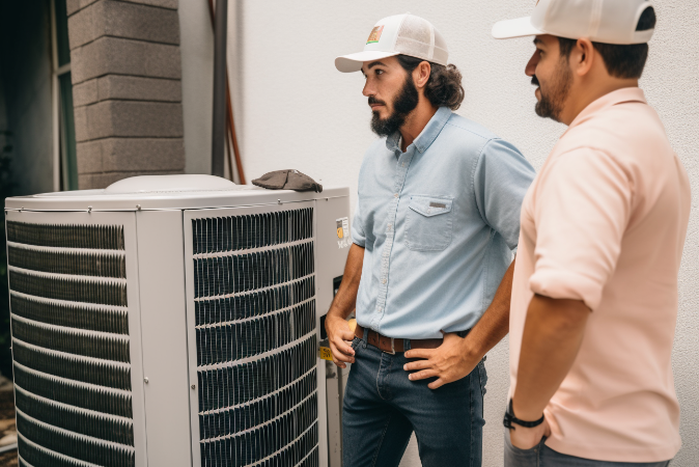
"After 15 years of service calls in Apopka, I can tell you that the systems lasting 20+ years all have one thing in common—their owners never skipped a seasonal tune-up. The units we're replacing at 8 or 10 years almost always have no service history at all."
Essential Resources for Choosing an HVAC Contractor in Apopka
Verify State Licensing Before You Hire
The Florida DBPR License Verification Portal confirms any contractor's active license status and reveals disciplinary history. Florida law requires all air conditioning contractors to hold valid state credentials—unlicensed work can void warranties and fail inspections. Source: Florida Department of Business & Professional Regulation
https://www.myfloridalicense.com/wl11.asp
Claim Up to $1,000 in Utility Rebates
Duke Energy's Home Energy Improvement program offers Apopka homeowners rebates on qualifying HVAC replacements, duct repairs, and efficiency upgrades. Complete a free Home Energy Check within 24 months of installation to qualify. Source: Duke Energy Florida
https://www.duke-energy.com/home/products/home-energy-improvement
Confirm Permits Are Pulled Properly
Orange County's Fast Track Portal lets you verify that contractors obtain required mechanical permits and schedule mandatory inspections. Unpermitted HVAC work can create liability issues and complicate future home sales. Source: Orange County Division of Building Safety
https://fasttrack.ocfl.net/OnlineServices/
Save Up to $2,000 with Federal Tax Credits
Energy Star's federal tax credit program offers up to $2,000 for qualifying heat pumps or $600 for high-efficiency central air conditioners installed through December 2025. Systems must meet Energy Star Most Efficient certification requirements. Source: U.S. Environmental Protection Agency / Energy Star
https://www.energystar.gov/about/federal-tax-credits
Research Contractor Reputation and Complaints
The Better Business Bureau's Central Florida directory shows ratings, customer reviews, and complaint resolution history for HVAC companies serving Apopka. Look for accredited businesses with A+ ratings and minimal unresolved complaints. Source: Better Business Bureau
https://www.bbb.org/us/fl/orlando/category/air-conditioning-contractor
Report Fraud and Access Consumer Protections
The Florida Attorney General's office provides HVAC-specific fraud prevention resources and accepts complaints against contractors engaged in deceptive practices. The AG has secured million-dollar settlements against predatory HVAC companies in Florida. Source: Florida Office of the Attorney General
https://www.myfloridalegal.com/consumer-protection/how-to-protect-yourself-contractors
Verify Technician Certifications
NATE (North American Technician Excellence) certification confirms technicians have passed industry-standard competency exams. NATE-certified professionals must complete continuing education every two years to maintain credentials. Source: North American Technician Excellence
Supporting Statistics
Federal research confirms what we see daily on service calls across Central Florida.
Improper Installation Wastes Up to 30% of System Efficiency
Energy Star reports improper HVAC installation cuts efficiency by up to 30%. We see this constantly in Apopka—new systems underperforming due to installation shortcuts.
Common installation faults we find:
Incorrect refrigerant charges
Undersized ductwork
Skipped load calculations
The real cost: On a $200 monthly summer electric bill, a 30% efficiency loss means $60 wasted every month.
Source: U.S. Environmental Protection Agency / Energy Star https://www.energystar.gov/saveathome/heating-cooling
Nearly Half of Home Energy Goes to Heating and Cooling
The U.S. Energy Information Administration reports heating and cooling account for nearly 50% of home energy use. In Apopka, that number runs higher.
What we see locally:
AC systems running 10-12 hours daily from May through September
Cooling costs reaching 60%+ of total energy bills
A system running 15% less efficiently adds hundreds to summer utility costs
This is why we push seasonal tune-ups. Small efficiency losses compound quickly over a Florida summer.
Source: U.S. Energy Information Administration https://www.eia.gov/todayinenergy/detail.php?id=52558
Americans Spend 90% of Their Time Indoors
EPA research shows Americans spend 90% of their time indoors. Our technicians think about this every time they find clogged filters or mold in condensate drain pans.
In Apopka's humidity, neglected systems don't just waste energy—they circulate:
Allergens
Mold spores
Stale, recirculated air
Customers regularly tell us their allergy symptoms improve within days of a thorough system cleaning. The maintenance-to-air-quality connection isn't abstract—families notice it immediately.
Source: U.S. Environmental Protection Agency https://www.epa.gov/indoor-air-quality-iaq
Final Thought: What We've Learned After Thousands of Apopka Service Calls
Seasonal HVAC maintenance isn't complicated. It's also not optional—at least not in Central Florida.
After years of emergency calls and system replacements, we've reached a simple conclusion: the systems that last 15-20 years all have consistent maintenance histories. The ones we replace at 8-10 years almost never do.
What Actually Moves the Needle
Most maintenance guides overcomplicate things. Here's what matters for Apopka homes:
Do these religiously:
Change filters monthly during summer—not quarterly
Schedule professional tune-ups before May and before December
Pour vinegar down the condensate drain line every 30 days in summer
Clear outdoor unit debris after every major storm
Skip the upsells on these:
Annual duct cleaning (every 3-5 years is enough)
UV light systems (helpful sometimes, unnecessary often)
Yearly refrigerant top-offs (if you need refrigerant annually, fix the leak)
Why Apopka Is Different
Central Florida pushes HVAC systems harder than almost anywhere else:
90°F+ heat for months
Humidity regularly above 80%
Daily afternoon thunderstorms
Hurricane season debris
January cold snaps that catch heat pumps off guard
That's not a sales pitch. It's physics. Skipping maintenance here has consequences homeowners in milder climates don't face.
The Bottom Line
We built this guide because we got tired of preventable emergencies:
Flooded ceilings in July
Heat pump failures on 40-degree January mornings
Compressor burnouts on the hottest day of summer
Every one of those calls costs more than a $150 tune-up would have.
If you take one thing from this page: Don't wait for something to break.
Schedule maintenance before you need it
Verify your contractor's license before they show up
Pull permit records after they leave
Change your filter more often than you think necessary
Your system lasts longer. Your bills stay lower. And you won't call us at 2 AM in August wondering why your house is 85 degrees.
FAQ on "HVAC Repair in Apopka"
Q: How do I verify an HVAC contractor is licensed to work in Apopka?
A: Search the Florida DBPR License Verification Portal at MyFloridaLicense.com.
After years of fixing botched installations, we've seen what happens when homeowners skip this step:
Voided warranties
Failed inspections
Work that needs complete redoing
If a contractor hesitates to provide their license number, find someone else. Also check Orange County's Fast Track Portal after the job to confirm permits were actually pulled.
Q: How much does HVAC repair typically cost in Apopka?
A: Most repairs we perform range from $150 to $500.
Typical cost breakdown:
Capacitor replacements: Lower end
Refrigerant recharges: Lower end
Blower motor replacements: Higher end
Compressor repairs: Higher end
Our honest advice: If repair costs exceed 50% of a new system's price, replacement usually makes more sense—especially on units past 10 years. We've seen too many homeowners sink $800 into a 15-year-old system only to face another major repair six months later.
Q: Why does my AC keep breaking down in summer?
A: Nine times out of ten, summer breakdowns trace back to skipped maintenance.
The pattern we see every year in Apopka:
Clogged condensate drain lines flooding ceilings in July
Dirty evaporator coils causing freeze-ups
Worn capacitors failing on the hottest afternoon of the month
Central Florida summers aren't kind to HVAC systems. Yours runs 10-12 hours daily in 90°F heat with 80%+ humidity. A spring tune-up catches these issues when they're $150 fixes—not $1,500 emergencies.
Q: Should I repair or replace my HVAC system?
A: We walk customers through a simple decision framework.
Replacement typically makes sense if:
System is over 12 years old and facing a major repair
You've called for service more than twice in the past year
You're still running R-22 refrigerant (phased out and expensive)
Repair estimate exceeds 50% of new equipment cost
Don't overlook available incentives:
Duke Energy rebates: Up to $1,000 back
Federal tax credits: Up to $2,000 for heat pumps through December 2025
We've had customers reduce their net replacement cost by $3,000+ by stacking these programs.
Q: How quickly can I get emergency HVAC repair in Apopka?
A: Most reputable contractors offer same-day or next-day service. During peak summer, wait times can stretch to 48 hours when call volume spikes.
Warning signs of contractors to avoid:
Pressuring you into immediate decisions
Demanding full payment before starting work
Using your discomfort as a sales tactic
Legitimate companies provide written estimates and give you time to verify credentials. We've heard too many stories from customers who got burned by rushing.
Here is the nearest branch location serving the Sunny Isles Beach FL area…
Filterbuy HVAC Solutions - Miami FL
1300 S Miami Ave Unit 4806, Miami, FL 33130
(305) 306-5027